AVID Learning Partner Logo

Promedia Blog - Page 16 

ProMedia Training's Blog brings the latest music technology, audio engineering, and Pro Tools training options.

Upcoming Pro Tools Training

2026 Pro Tools Certification Calendar
Live-Online AVID Learning

Dolby Atmos Certification: Sept 12, 13, 19, 20, 26, 27
PT101+110 Nights: Sept 14, 15, 17, 21, 22, 24, 28, 29
PT101+110 Wkend: Oct 10, 11, 17, 18, 24, 25
PT101+110 Wkday: Oct 12, 14, 16, 19, 21, 23
PT101+110 Nights: Nov 9, 10, 12, 16, 17, 19, 23, 24

MIXING - SSL Certified: Nov 14, 15, 21, 22
PT201+210Music Wkend: Nov 7, 8, 14, 15, 21, 22
SEE MORE DATES

In-Person Los Angeles ( 32 hrs, 10am-6pm PST)
PT101+110: Oct 8, 9, 10, 11
PT101+110: Nov 5, 6, 7, 8
PT101+110: Dec 3, 4, 5, 6
Register: 888-277-0457

SSL Certified Mixing Masterclass
Nov 14, 15, 21, 22 (live-online)
1pm - 5pm EST / 10am - 2pm PST

Upcoming Pro Tools Training

Live Online Pro Tools Certifications
AVID Learning Partner Calendar
Dolby Atmos Certification: Sept 12, 13, 19, 20, 26, 27
PT101+110 Night: Sept 14, 15, 17, 21, 22, 24, 28, 29

PT101+110 Wkend: Oct 10, 11, 17, 18, 24, 25
PT101+110 Night: Nov 9, 10, 12, 16, 17, 19, 23, 24
P201+210Music Wkend: Nov 7, 8, 14, 15, 21, 22

3–4 hrs per class / 6–8 Day Course

In-Person Los Angeles (32 hrs. 10am–6pm PT)
PT101+PT110: Oct 8, 9, 10, 11
PT101+PT110: Nov 5, 6, 7, 8
PT101+PT110: Dec 3, 4, 5, 6
SEE MORE DATES

Mixing in Pro Tools: SSL Certified 
Nov 14, 15, 21, 22 (live-online)
1pm - 5pm EST / 10am - 2pm PST

Register: 888-277-0457

xx

The art of hand-writing sheet music is becoming easier with the advances technology has made in assisting in this process. In this article, we'll discuss some basic techniques for using the "Score Editor" in Pro Tools to arrange and print sheet music with proper notation that musicians can easily read. There are a few guidelines that are very important to understand first for the process to initiate properly. First, you must know the key of the song that you are intending to score. It is also important to know the key of the instrument you are printing for, as many instruments are tuned to different keys. Most trained musicians can still translate even if you print in "Concert C"; but it is most appropriate if their parts are transposed to the key of their unique instrument.

Setting the Key in Pro Tools

skpt1and2

  1. From the Key Ruler, either click the "+" from the side column of the rulers view, or right-click on the ruler at a point at which you would like to add a key change. It is possible to add key changes throughout the session, and transpose MIDI data accordingly, but that is a topic for another day. Right now, let's just get the key of the song inserted at the beginning of the session.

Before we begin, we created a session that you can download and listen to after you read this article, and use as a template for other songs. This template can assist you in creating SideChain Compression in your own mixes. You will find this link at the bottom of this article.

Compression is a very commonly used technique in Hit Dance Music for making various instruments within a song swell up and down. They usually swell down when a kick drum, or beat hits, and back up in between the space between hits. I’ve created a session that you can download and use to listen to, and use as a template for other songs, if you like. This a quite simple process that will go a long way in dance music, so buckle your seatbelts and keep your hands and feet in the car throughout the duration of the ride. Here we go! And if you like what you see below, feel free to join me for a hands-on Pro tools class in person at ProMedia Training.

First, I created an instrument track,

sidechain1

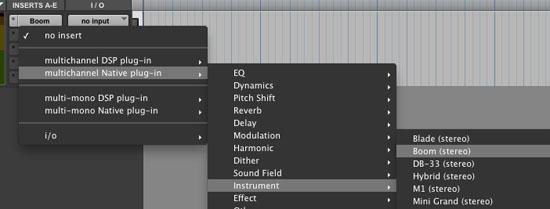
And then inserted Boom on it:

sidechain2

I’m going to use it as a trigger, or sidechain, for the other tracks that need to swell or pump. By programming a quarter note bass drum pattern, also known as "four on the floor" to musicians, this will be the source of the other tracks to swell between. Here’s how I did it. You can follow along, or download the session, which is already done.


thunder1So what’s the scoop on the new Pro Tools|HD Native Thunderbolt interface and PCIe card? Brace yourselves because the future is coming and it’s coming quick. It has been a long time since we have really seen something new in the computing world that can be considered a "next step". It’s been many years since USB and FireWire burst on the scene and allowed easier connectivity of various peripheral devices such as printers, hard drive, audio interface, midi controller, etc... We are on the cusp of the next great innovation that is about to be unleashed on our collective computing experience, Thunderbolt.

Developed by Intel, Thunderbolt (also known as Light Peak) is an ultra high speed connection technology that combines PCI bandwidth along with DisplayPort technology. There is no comparison to USB or FireWire, as it is not a continuation of an existing technology. We are looking at the new standard that can replace all of our current connectors.


Vocal Effects In Your Mix

We all like to hear a little reverb, maybe some delay, or any number of creative fx tools we have available to us in audio land. Here's how to get it done.


There is a lot of back and forth in music about "genre" and "sub-genre" mainly because everyone likes to think of themselves as different from everyone else making music. Truth is, most of us are looking for the same thing- radio play. If you haven’t noticed, radio is still the primary medium that most of us hear our new music. Getting played on the radio equates to money, mullah, dinero, cheddar, cake etc.... Furthermore, it means that the more our songs are played on the radio, the higher up the Billboard charts the song will climb, hopefully landing in the Hot 100 and Top 40. Look at the Billboard charts today and you will see music and bands from every genre imaginable: dance, hip hop, country, rock, whatever it is you want to call it; but Pop Music is what it truly is. Now that we have that out of the way we can start looking at what most of these songs have in common.

If we start listening to what a lot of the Top 40 songs have in common, it becomes obvious that there is a lot of presence in the vocal sound and tone. Listen to songs by Usher, Carrie Underwood, Lil Wayne, Five Finger Death Punch, Kylie Minogue, and even Justin Beiber, we start to see how present and "big" the vocals of these songs sound, right in your face! The sound is telling you "this is something to pay attention to". DISCLAIMER: Even though we are talking about vocals, this same technique is also utilized for instruments as well, such as guitar, drums, key’s, etc… This "popular" sound utilized by top producers today is accomplished by vocal layering and placement techniques. Let’s look at some basic principles to help you with layering.


ptusergroups

Join ProMedia Training for our PRO TOOLS USER GROUPS. This free 3 hour workshop at focuses on current music production techniques in Pro Tool 10, by the foremost Pro Tools expert and educator, Mihai Boloni.

Do you have Pro Tools questions? Are you frustrated by lack of available information and answers to your questions? Do you want to meet fellow Pro Tools Users, Musicians, Engineers, Producers, and people like yourself? An AVID Certified Pro Tools instructor will answer your questions, and conduct a topic driven seminar covering areas such as Recording, Mixing, Music Productions, etc.

This invitation only event is brought to you by ProMedia Training as a gift for you to experience and learn how to take your music production to the next level.


joshharris1It’s been almost 20 years since digital recording has been a part of the mainstream. Back in the day, tracking sheets and mix notes were a part of everyday recording sessions, and we weren’t using words like file management and session templates. I fondly remember my first Pro Tools rig: a beige G3 with an Audiomedia 3 card, running Pro Tools 4.x. If I remember correctly, I was limited to 8 tracks of audio, but boy was it cool to have 8 tracks! At the time, I was extremely ignorant to the importance of workflow, and I just plodded along, with sessions taking as long as they took. That was back in the mid to late 1990’s, and now that I’ve been working in the business as a full-time producer, engineer, remixer and songwriter for over 10 years, I am constantly looking for ways to streamline my workflow.

Learn more about JOSH HARRIS...


There's a certain feeling I get when I listen to a finished piece of recorded music. A finished production just hits me in a particularly different manner than roughs or 'almost finished' tracks. Yes, part of it is the mixing and mastering, but a bigger part of it is the layering of sounds. As a keyboard player, I spent most of my younger years experimenting with layering synth and drum sounds via MIDI for both live and studio applications. Getting a handle on this part of the production process does not happen overnight, and it requires quite a bit of experimentation to dial in that perfect combination of frequencies.


On The Road

There are many things that people ask me about my work, however, amidst all the star-struck banter, not very many people ever ask how much work went into what I do. The truth is "A Metric Ton" of work went into being here today.  


Building a Guest House studio (Part III)

Hey there, welcome back! Here’s the next update of the progress of the studio build. Back from a couple classes on the road and time to get to work again. The plan this trip was to finish wrapping the wall panels in fabric, build the desk and racks, so here we go!